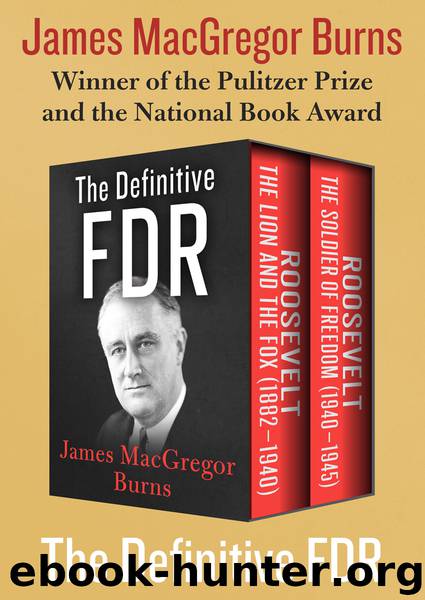
The Definitive FDR by James MacGregor Burns
Author:James MacGregor Burns
Language: eng
Format: epub
ISBN: 9781504047708
Publisher: Open Road Media
Published: 2017-07-27T00:00:00+00:00
Harold Carlisle, The Des Moines Register and Tribune Syndicate, from the Washington Post, April 29, 1941
May 5, 1941, Rollin Kirby, reprinted by permission of the New York Post
Roosevelt hoped that stepped-up patrolling would help in the Atlantic. Then, he told Stimson and Knox late in April, he could inform Latin-American capitals about Axis raiders. Stimson bridled. “But you are not going to report the presence of the German Fleet to the Americas. You are going to report it to the British Fleet.” With his simplicity and directness and his narrower military responsibilities, he wanted Roosevelt to be honest with himself. The President must take the lead and also the risk, Stimson felt, for the public would not tell him ahead of time if they would follow him. But the President would not lead.
Was Roosevelt hoping that patrolling would trigger an incident that would dramatize Hitler’s threat to the hemisphere and unite Americans behind a bolder strategy? Ickes and others were convinced that he was. But evidently no ordinary incident would do. On April 10 the American destroyer Niblack, while picking up survivors from a torpedoed Dutch merchantman, had made sound contact with a submarine and had driven it off with depth charges. This episode—the first military encounter between American and German armed forces—Roosevelt had not used to dramatize the emergency. What was he waiting for?
A deepening crisis of confidence enveloped the administration in May. No one knew what was going to be done, Stimson complained. Morgenthau, who had now concluded that the United States must go to war to save Britain, felt that both Roosevelt and Hopkins were groping as to what to do. Wallace wrote that the farm people of Iowa were ready for a “more forceful and definite leadership.” Hopkins at one moment defended the President and in the next urged the military leaders to press their chief harder. In a tragicomic moment Stimson actually interrupted Hull’s croquet game to enlist support for a changed policy. The croquet player continued his game. Roosevelt’s personal friends—MacLeish, Frankfurter, William C. Bullitt—were deeply troubled. Ickes met secretly with Stimson, Knox, and Jackson to discuss ways of putting pressure on the President; all agreed that Roosevelt was failing to lead, that the country wanted more action and less talk, that something dramatic was needed to seize the attention of the world. It was Stimson who finally belled the cat. The people, he told the President to his face, must not be brought to combat evil through some accident or mistake, but through Roosevelt’s moral leadership.
Why was Roosevelt so passive? His lieutenants searched for clues. He was in and out of bed with an enervating fever during much of May, but he seemed no more militant during his ups than his downs. He was watching Congress and public opinion warily—especially an anticonvoy resolution in the Senate—but he seemed no more purposeful after the resolution was blocked. Clearly he felt constrained by his peace pledges—to Stimson, he seemed “tangled up in the coils of
Download
This site does not store any files on its server. We only index and link to content provided by other sites. Please contact the content providers to delete copyright contents if any and email us, we'll remove relevant links or contents immediately.
Fanny Burney by Claire Harman(26659)
Empire of the Sikhs by Patwant Singh(23135)
Out of India by Michael Foss(16985)
Leonardo da Vinci by Walter Isaacson(13410)
Small Great Things by Jodi Picoult(7221)
The Six Wives Of Henry VIII (WOMEN IN HISTORY) by Fraser Antonia(5557)
The Wind in My Hair by Masih Alinejad(5137)
A Higher Loyalty: Truth, Lies, and Leadership by James Comey(5017)
The Crown by Robert Lacey(4861)
The Lonely City by Olivia Laing(4841)
Millionaire: The Philanderer, Gambler, and Duelist Who Invented Modern Finance by Janet Gleeson(4537)
The Iron Duke by The Iron Duke(4404)
Papillon (English) by Henri Charrière(4322)
Sticky Fingers by Joe Hagan(4253)
Joan of Arc by Mary Gordon(4155)
Alive: The Story of the Andes Survivors by Piers Paul Read(4076)
Stalin by Stephen Kotkin(4003)
Aleister Crowley: The Biography by Tobias Churton(3671)
Ants Among Elephants by Sujatha Gidla(3494)
